



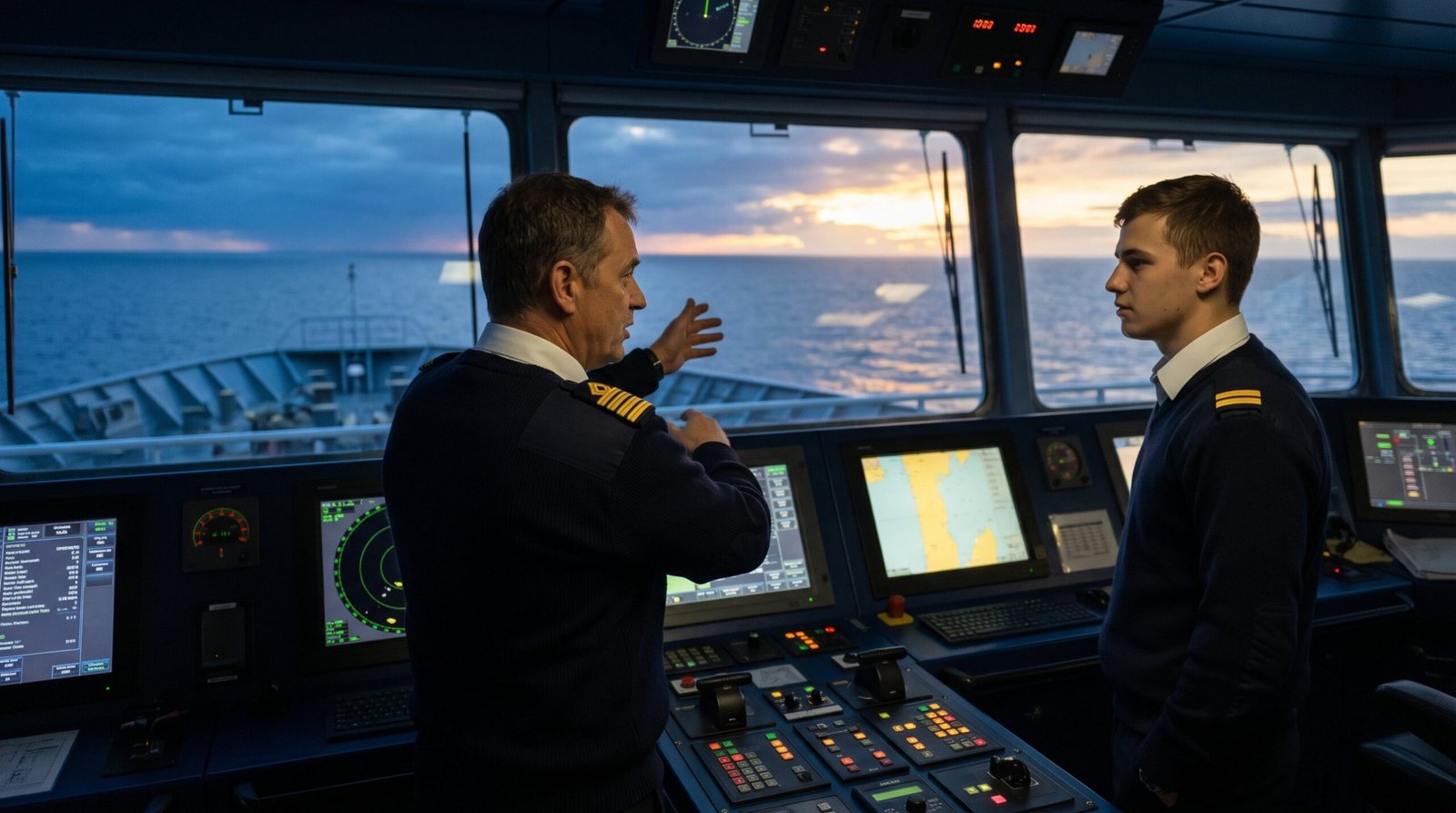
From a cadet placement to the captain’s bridge usually takes ten years or more. A seafarer’s career is measured in months of sea service confirmed by entries in the service record book. That is why it’s worth having a plan as early as your first year of study.
Officer training: the start at a maritime university
Officer training begins at a maritime academy or university in navigation or ship power engineering. During their studies, cadets complete sea service on ships. For an officer-in-charge-of-a-watch diploma, the STCW convention requires at least 12 months of approved sea service within the training programme.
After graduating and passing the exam at the Maritime Administration, you receive your first officer diploma: third officer or fourth engineer.
The path from cadet to chief officer
The typical line for the deck department looks like this:
| Position | What you need to hold it |
|---|---|
| Cadet | admission to a maritime university |
| Third officer | an officer-in-charge-of-a-watch diploma: study, 12 months of service, an exam |
| Second officer | the same diploma; the position depends on experience and the company’s decision |
| Chief officer | at least 12 months as officer in charge of a watch, a new diploma and an exam |
| Captain | 24–36 months of service in management-level positions, a master’s diploma |
Each seafarer rank promotion requires a new diploma: you need to accumulate service, take courses and pass officer diploma exams. A position on board without the corresponding diploma does not entitle you to the next step.
Not sure you chose the right path?
Stella Maris psychologists work with cadets and students of maritime universities: they help with career planning and adjusting to study. The first three sessions are free.
How to become a captain: service requirements
Under STCW, the requirement for a captain of a ship of 3,000 gross tonnage or more is at least 36 months of sea service as officer in charge of a watch. This period is reduced to 24 months if at least 12 of them were spent as chief officer.
Besides service, a captain must speak English at a level sufficient for negotiating with port services and agents. Companies also often look at experience with a specific ship type and recommendations from previous captains.
The engine department: working as a chief engineer
In the engine department the path is similar: fourth, third and second engineer, then chief engineer. The service requirements for a chief engineer on ships with main engines of 3,000 kW or more are the same: 36 months in engineer positions, or 24 if 12 of them were as second engineer. Working as a chief engineer is valued on the market no less than being a captain.
Where the limit is: what service doesn’t measure
Service and diplomas open doors, but they don’t guarantee that you will cope with responsibility for a crew. A seafarer’s professional development also includes the ability to manage people, resolve conflicts and hold up under stress. This isn’t tested in an exam, but it shows at sea.
A seafarer’s career is built from sea service, diplomas and skills that aren’t recorded in the service record book. Count how many months you are short of your next diploma and plan your contracts around that goal.
Planning your career and budget years ahead?
The free financial awareness course from Stella Maris and the Lviv Business School of UCU will help you plan your money between contracts and study.
Read also: Seafarer Documents: Which Certificates and Diplomas You Need to Renew — how to revalidate diplomas at each stage of your career.





 We send our newsletter only once a month.
