



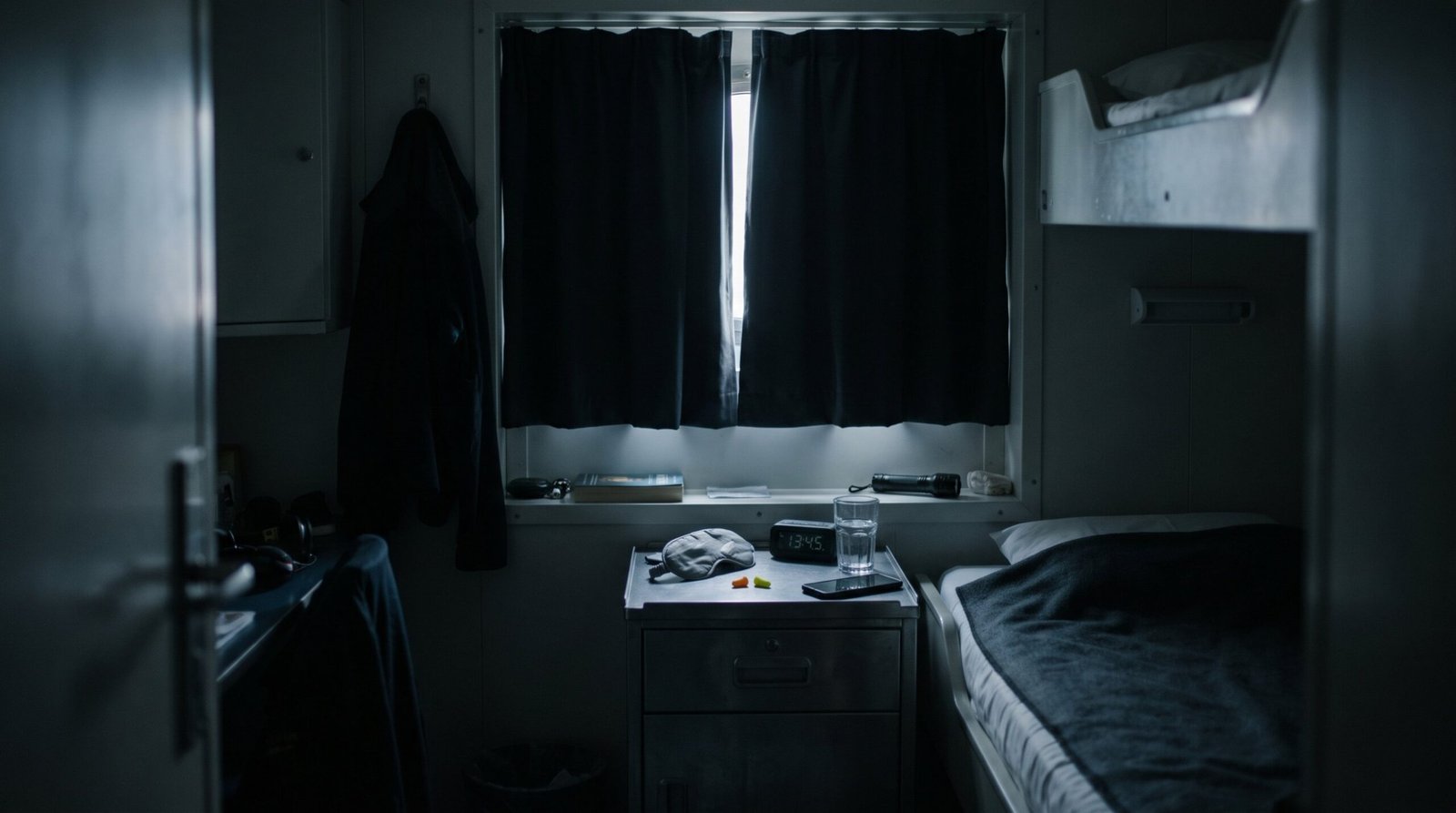
A watch from midnight to four, a few hours of sleep, mooring at eight, and another watch. Sleep at sea is rarely continuous, and the body can’t tell what time it is: night or day. The quality of sleep on a ship falls gradually, and after a few weeks of this schedule even an experienced seafarer notices that their reactions have slowed.
The body clock on a watch schedule
A person’s internal clock is tuned to light and darkness. On a ship it is thrown off by watches that cut the night into pieces, and by artificial lighting around the clock. The body clock adapts to a watch schedule if the schedule is stable, and breaks when it keeps changing.
The MLC requires at least 10 hours of rest in every 24, and they may be divided into no more than two periods, one of which must be at least 6 hours long. Those 6 hours are what you should protect for sleep.
Time-zone changes at sea
When a ship sails east or west, the clocks are changed, often by an hour at a time. Time-zone changes at sea accumulate, and after a week of passage you are living in a completely different rhythm. It helps to eat and get daylight according to the ship’s local time, not by habit.
Is your insomnia caused by anxiety rather than watches?
If you can’t fall asleep because you keep thinking about your family, money or the war, talking to a psychologist can help. Stella Maris psychologists work with seafarers online, and the first three sessions are free.
How to fight insomnia on a ship
What works in practice:
- go to bed straight after your watch instead of scrolling your phone for an hour;
- don’t drink coffee or energy drinks later than 5–6 hours before sleep;
- darken the cabin and cover the porthole with a curtain;
- use earplugs or headphones with white noise if you don’t know how to fall asleep with engine noise;
- don’t eat a heavy meal before sleep.
Rest between watches is not only sleep. A short walk on deck or some stretching also relieves tension and helps you fall asleep faster afterwards.
Chronic sleep deprivation in seafarers: when to sound the alarm
A seafarer’s chronic sleep deprivation isn’t noticeable at once. The signs are these: you fall asleep within minutes anywhere, you’re constantly irritable, you make mistakes in simple operations, you forget small things. Fatigue on watch is one of the common causes of maritime accidents, so this is not something to turn a blind eye to.
If insomnia lasts several weeks, tell the captain or the person responsible for medical care on board. Sleep disorder in seafarers is a recognised problem, not a weakness.
Where the limit is: sleeping pills
Seafarers often ask which sleeping pills are safe. The answer depends on your health, and it is for a doctor to give. Most sleeping pills reduce concentration the next day, and for a person on watch that is a risk. Don’t take medication without a prescription and don’t take what a colleague recommended.
Sleep at sea depends on a stable schedule, darkness, quiet and how calm your head is. Start by protecting the longest period of rest between watches.
Can’t sleep because of stress?
Stella Maris psychologists help seafarers cope with anxiety and overtiredness during a contract.
Read also: A Comfort Zone in Your Cabin: How to Create a Cosy Space for Your Contract — how to set up light and sound in your cabin for sleep.







 We send our newsletter only once a month.
