




A watch, fatigue, the fourth month of a contract — and suddenly you’re shouting at the junior engineer over a trifle. Or you’ve come home after months of waiting, and within a week you’re slamming doors over toys left on the floor. Then come shame, apologies, a promise to yourself: “never again.” And then it happens again.
Irritability is one of the most common reasons people of the sea come to a psychologist. The good news: managing anger can be learned, like any professional skill. This article explains why anger builds up, how to notice it before it explodes, and what to do in the moment so you don’t damage relationships with your crew or your family.
Anger is not the enemy but a signal
Anger in itself isn’t bad. It’s a natural emotion that tells you: “something is crossing my boundaries, something is unfair, something is a threat.” Without anger, people couldn’t protect themselves and those they love.
The problem isn’t anger, but how it comes out:
- Healthy anger — noticing the irritation, understanding its cause and calmly saying: “This doesn’t work for me.”
- Destructive anger — shouting, insults, slamming doors, putting others down, followed by guilt and distance.
The goal isn’t to stop getting angry, but to learn to choose what you do with your anger.
Why seafarers are especially prone to outbursts
The seafaring profession combines almost every factor that amplifies irritability. This isn’t a “bad temper” — it’s the conditions.
- Chronic fatigue. The watch schedule disrupts sleep, and a sleep-deprived brain is worse at putting the brakes on emotions.
- Confined space. On a ship, you can’t “go for a walk” away from someone who annoys you. For months you see the same faces.
- High responsibility. A mistake can cost the ship’s safety, so tension is constant.
- Hierarchy. Anger towards a senior officer often has to be held back — it builds up and then explodes at those “below” or at loved ones.
- Switching modes. On board — clear orders and execution. At home — negotiation, compromise, children who don’t listen the first time.
- Worrying about home. War, the news, being unable to physically protect your family. Helplessness often disguises itself as anger.
If you recognised your situation in this list, you are not “a broken person.” Your nervous system has simply been running in overload mode for a long time. We wrote about how chronic stress builds up in How Seafarers Can Cope with Chronic Stress.
The anger scale: how to spot an explosion before it happens
Anger rarely jumps from zero to a hundred. It builds — and it has early warning signs. Psychologists often suggest imagining a scale from 0 to 10.
- 0–3: irritation. Everything rubs you the wrong way a little, you want quiet, your answers get short.
- 4–6: tension. Your jaw clenches, your voice sharpens, your thoughts circle around the grievance.
- 7–8: the edge. Heart pounding, face hot, fists clenched, an urge to shout.
- 9–10: explosion. Shouting, insults, hitting objects. At this stage thinking is almost impossible.
The key rule: act at level 4–6, not at 9. Once you’re already shouting, no technique will work. So the first step is learning to notice your own early signals.
Typical physical “beacons” of anger:
- Clenched jaw or fists.
- Heat in the face or neck.
- Faster breathing.
- Tension in the shoulders.
- Thoughts like “he’s doing it on purpose,” “it’s always like this,” “that’s enough.”
What to do in the moment: 5 techniques that work
1. Stop-pause
As soon as you notice you’re “boiling,” say to yourself (or out loud): “Stop.” Pause the conversation for a few seconds. This interrupts the automatic reaction and gives you back control.
2. Breathe out longer than you breathe in
Take a slow breath in for a count of 4 and breathe out for 6–8. Repeat 5–6 times. A long exhale signals to the nervous system that there is no danger and helps ease the tension a little.
3. An agreed time-out
In advance, at a calm moment, agree with your partner: “If I say ‘I need a pause,’ I’ll step out for 20 minutes and come back to the conversation.” Coming back is essential — otherwise a time-out turns into running away.
4. Name the emotion
Tell yourself: “I’m angry because I’m tired and I wasn’t heard.” Research shows that putting an emotion into words reduces its intensity. The brain shifts from reacting to reflecting.
5. Movement instead of a blow
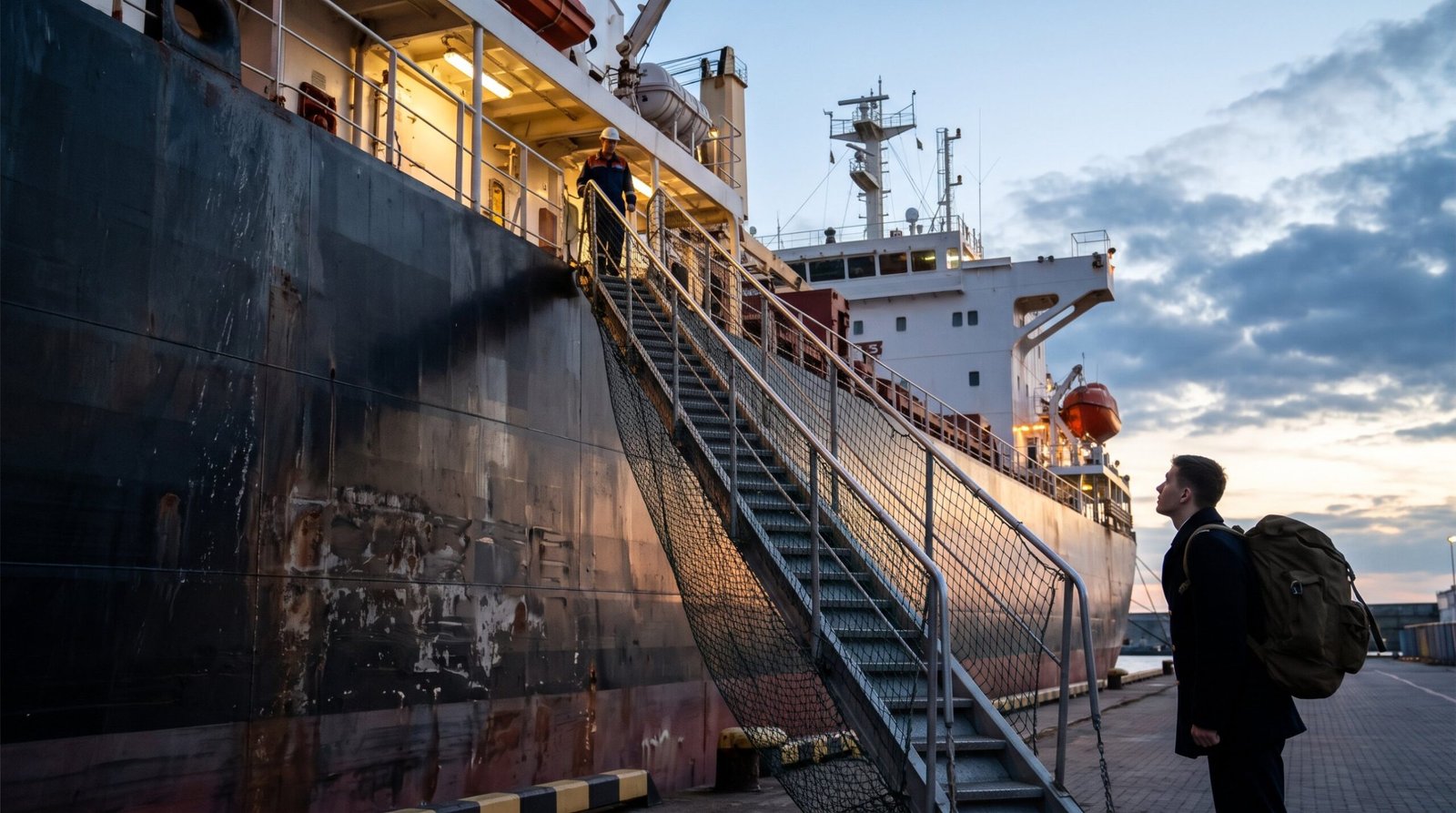
If the energy of anger is bursting out, take a walk, go down the gangway, do a few squats, splash your face with cold water. Physical action helps “burn off” tension without harming the people around you.
We collected a few more quick self-help exercises in Control the Storm Within.
Anger on board and anger at home: different rules
On board
On a ship, irritation affects not only relationships but also safety. A conflict on the bridge or in the engine room can lead to a mistake.
- Talk about facts, not the person: “The valve isn’t closed” instead of “you’ve messed everything up again.”
- Postpone a difficult conversation until the end of the watch if the situation isn’t critical.
- If a conflict keeps repeating, go to a senior officer rather than letting it build up.
- In mixed crews, remember cultural differences: what sounds neutral to you may be offensive to a colleague. More in Cultural Barriers in Mixed Crews.
At home
At home you don’t “command” — you negotiate. Especially in the first weeks after a voyage.
- Warn your family: “I need time to switch over. If I’m sharp, it’s not about you.”
- Use “I-statements”: “I’m tired and it’s hard for me when it’s noisy” instead of “you’re driving me crazy.”
- Don’t settle serious issues when you’re hungry, tired or short of sleep.
- Children need an explanation after an outburst: “I shouted because I was angry. It’s not your fault. I’m sorry.”
After an outburst: how to reconnect
Even people who manage their emotions well sometimes lose it. What matters is not whether an outburst happens, but what you do afterwards.
- Cool down. Don’t return to the conversation while you’re still at 7 on the scale.
- Own it without a “but.” “I shouted at you. That was wrong.” No “but you also…”.
- Explain what was happening with you. Not as an excuse, but so the other person understands.
- Offer a different way next time. “When I feel myself boiling over, I’ll say ‘pause’ and step out.”
Myths about anger that get in the way
- “You need to let off steam — punch a pillow or shout.” Psychologists have long observed that such “release” usually doesn’t reduce anger, but trains the habit of reacting aggressively.
- “A man has to be tough.” Strength is control over yourself, not over others.
- “Alcohol helps you relax.” In fact, alcohol weakens self-control, and that is exactly when the worst arguments tend to happen.
- “That’s just my character, nothing to be done.” Emotional regulation is a skill. It can be learned, just like keeping a logbook.
When to see a psychologist
Self-help techniques work, but sometimes professional support is needed. Seek help if:
- outbursts of anger happen every week or more often;
- your loved ones say they are afraid of your reactions;
- anger turns into breaking things, threats or physical aggression;
- after an outburst you feel shame and guilt for a long time, but can’t change anything;
- irritability comes with sleeplessness, a sense of emptiness or detachment.
If anyone’s safety is at risk, don’t wait: seek help immediately, and in a dangerous situation call 102 (police in Ukraine) or the local emergency number.
Working with anger is one of the topics Stella Maris programme psychologists encounter most often. It is also where results are often visible fastest: over the course, participants learn to recognise their triggers, stop in time and respond consciously, and their loved ones notice that home has become calmer. More on the signs that it’s time to see a specialist — in 7 Signs a Seafarer Needs to See a Psychologist.
Frequently asked questions
Why am I angrier with my family after a voyage than on board?
On board you hold back emotions for months because of hierarchy and responsibility. At home, in a safe environment, the built-up tension finally comes out. Besides, home has none of the clear rules and orders your mind has got used to.
Can I learn to control anger on my own?
Yes, the basic techniques — the anger scale, the pause, breathing, I-statements — work well on your own. But if outbursts are frequent or are damaging relationships, working with a psychologist helps uncover the deeper causes.
How long does it take to learn to manage emotions?
People often notice the first changes within a few weeks of regular practice. A lasting skill takes a few months to form. The Stella Maris programme offers 9 sessions over about two months — usually enough time to feel the difference.
Can I work with a psychologist from on board?
Yes, sessions take place online. If the ship’s internet is stable, you can join from on board at a time that suits you.
Free psychological support for people of the sea
The “People of the Sea” programme by the charitable organisation Apostleship of the Sea Stella Maris Ukraine offers:
- 9 free individual sessions with a psychologist;
- online, from anywhere in the world — on board, in port or at home;
- the option to choose your psychologist from the programme team;
- flexible scheduling across time zones;
- full confidentiality.
Leave a request on the Psychological Support page — our administrator will contact you and help you get started.
This article is for information only and does not replace an individual consultation with a specialist.




 We send our newsletter only once a month.
