


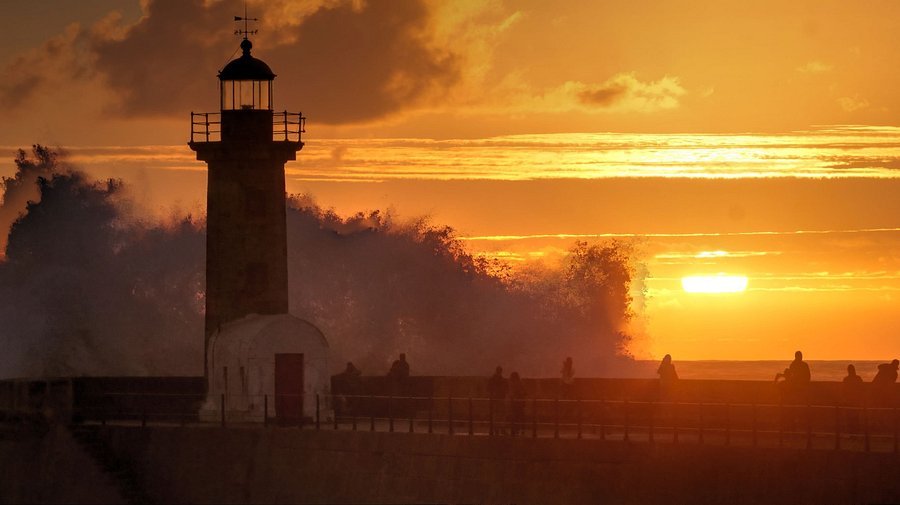
Some lighthouses stand alone. Others stand in the middle of city life — where fishers head out to sea in the morning and families walk the waterfront in the evening. The Felgueiras lighthouse in Porto is the second kind. It stands at the tip of the northern breakwater at the mouth of the Douro river, where it pours into the Atlantic Ocean — and every day it witnesses both shores of human experience: work and rest, danger and beauty, departure and return.
For seafarers, it is a navigational mark. For the city, a symbol. For those who know it closely — something more.
Porto and the Sea: A City That Always Faced West
To understand Felgueiras, you first need to understand Porto.
This city was built with its back to the land and its face to the sea. The Douro river, crossing it from east to west and reaching the Atlantic a few kilometres from the centre, has always been its main artery: trade, fishing, vineyards on the terraced hillsides — and above all, access to the open ocean.
It was from these shores that Portuguese navigators set out in the fifteenth and sixteenth centuries and changed the map of the world. Vasco da Gama, Magellan, Cabral — their routes began on this coastline. Portugal became the first European nation to open Atlantic trade routes, and Porto was at the heart of that age.
But the same Atlantic that opened new continents was merciless in return: storms at the mouth of the Douro were notorious for their unpredictability. The river entrance is narrow, with sandbars that shift after every storm. Ships sank here, fishers died here. And it was precisely here, to stop those losses, that a lighthouse was built.
Felgueiras: A Small Lighthouse with a Large Role
The Portuguese often say farolim de Felgueiras — farolim, a diminutive, meaning a little lighthouse. And in terms of scale, it does not overwhelm. A low round tower at the end of the Molhe Norte breakwater, its red-and-white striped paint making it unmistakable by day, and a flashing red light marking it at night.
But its position is unique. It stands literally on the boundary: to the right, the open Atlantic; to the left, the mouth of the Douro and Porto beyond it. For a vessel entering the river, the lighthouse marks the right edge of the safe channel. For a fishing boat returning in darkness, it is the first point of orientation before the final manoeuvre into port.
The structure dates to the nineteenth century — an era when Portugal was systematically building navigational infrastructure along its entire Atlantic coastline. A round tower on a massive stone base projecting from the breakwater tip: this is the classic form of a harbour entrance lighthouse, not built for the open ocean, but positioned precisely where it is needed — to guide vessels through the final approach.
Across the channel, on the southern breakwater, stands the Leixões port lighthouse. Together they frame the entrance channel from both sides — two lights, and between them a safe passage.
The Fishers of Matosinhos and Porto’s Living Sea
A few kilometres north of Felgueiras lies the fishing port of Matosinhos. This is not a tourist attraction or a maritime heritage museum. It is a working fishing port, active every day: trawlers that go out overnight and return in the morning with their catch, fish auctions where sardines and hake change hands before the city has woken up.
The fishers of Matosinhos know the Felgueiras lighthouse not as an architectural landmark but as a working mark. For them it is a point on the route — just as for a Ukrainian fisher, a buoy at the exit of the Dnipro estuary or the lighthouse at the entrance to Kherson port serves the same purpose.
The language of lighthouses is the same everywhere. Whether you are putting to sea from Porto, from Odesa or from Berdiansk, the logic is identical: find the light, align your heading, enter the safe channel. This is the international grammar of navigation — it requires no translation.
Portugal and Ukraine: Two Maritime Nations, One Network
At first glance, Porto and Odesa seem far apart. Different seas, different languages, different histories. But there are things that connect them more deeply than might appear.
Both are maritime nations with centuries of seafaring tradition. Both have fishing communities whose lives run to the rhythm of the sea, whatever is happening on land. Both have merchant fleet seafarers who spend months aboard vessels far from their families. Both have port cities where maritime identity is woven into daily life as naturally as the smell of salt in the air.
And in both countries — Stella Maris is present.
The international Catholic network of maritime apostolate — the Apostleship of the Sea — operates in more than 300 ports worldwide, including ports in Portugal and Ukraine. This means the same principle of support for seafarers that operates in Porto operates in Odesa too. The same values — presence, attention, service without conditions — at different points on one global maritime map.
What the Lighthouse Sees
The Felgueiras lighthouse sees the same thing every day — and never quite the same thing.
In the morning — fishing boats returning from a night at sea. During the day — container ships entering Leixões, one of the largest ports on the Iberian Peninsula. In the evening — tourists walking the breakwater and photographing the sunset over the Atlantic. At night — the solitary lights of vessels on the horizon and stars above the water.
But there is one thing it sees constantly: people. Fishers who depend on it as an orientation point. Seafarers who remember its red light as the first sign of coming home. Locals for whom it is part of the landscape and part of their identity.
The lighthouse says nothing in words. But it is present — and that presence is its work.
Stella Maris Ukraine: The Same Presence, a Different Shore
Stella Maris Ukraine is an international Catholic organisation of maritime apostolate that has worked for 20 years alongside those who go to sea: seafarers, fishers, port workers and maritime cadets. And with their families — those who remain on shore and wait.
Working with seafarers is not a one-off action. It is a sustained presence. Psychological support — individual and group sessions, online consultations, self-help materials — for those living through long separation, the stress of a voyage, or a difficult return home. Education programmes in financial literacy — because a family’s stability depends not only on how much a seafarer earns, but on how that family manages life in the rhythm of his or her absence and return.
And alongside all of this — chaplains. People who simply show up. They visit vessels, talk with crews, listen. For someone who has been at sea for months, the chance to speak with someone present and outside the ship’s hierarchy is not a small thing. It is often the only bridge between a person and the shore.
Seafarers carry trade routes, fisheries, port logistics — an invisible infrastructure without which a country cannot function. Yet they are often out of sight. Stella Maris Ukraine is one of the few organisations that sees them.
A Lighthouse Lives as Long as Someone Tends the Light
Felgueiras stands where the Atlantic begins — or ends, depending on which direction you are facing. For those heading out to sea, it is the last familiar point of land. For those returning, the first sign of home.
Seafarers around the world — in Porto, in Odesa, in Matosinhos, in Kherson — deserve the same steady presence alongside them.
Stella Maris Ukraine produces small wooden lighthouse figurines — a symbol of presence, attention and connection to the seafaring community. They can be received as a gesture of thanks for a charitable contribution to the organisation, or simply acquired as a reminder of those who go each day to where the land ends.
Each figurine is participation in something larger than a keepsake. It is a way of saying: seafarers matter. Their work, their families, their resilience — matter.
 We send our newsletter only once a month.